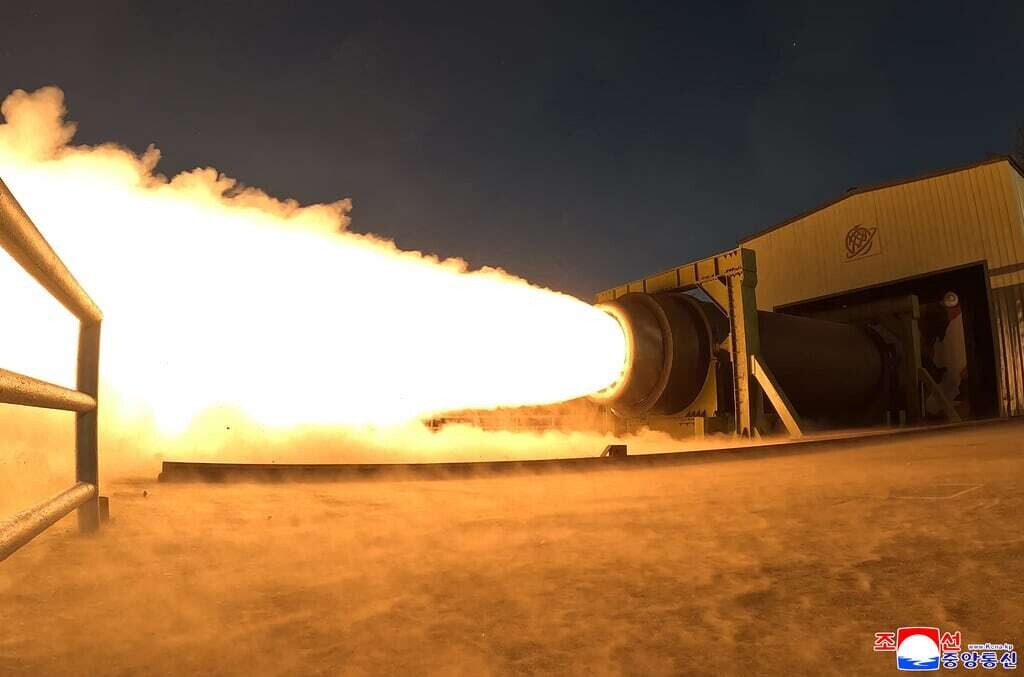
The leader of North Korea, Kim Jong Un, observed a test of a high-thrust solid-fuel military engine and praised it as an advance to strengthen the country's strategic military capability, state press reported on Sunday. The test likely indicates that Kim is determined to expand and modernize an arsenal of missiles capable of reaching the continental United States. The report from the Korean Central News Agency on Sunday came days after Kim addressed the North Korean Parliament, where he pledged to irreversibly solidify his country's status as a nuclear power and accused the United States of “state terrorism and aggression” globally, in an apparent reference to the war in the Middle East. What are the characteristics of the missile engine tested by North Korea? Kim witnessed the ground test of the recently improved engine, which uses a carbon fiber composite material, according to KCNA, which reported that the engine's maximum thrust is 2,500 kilotons, compared to the approximately 1,971 kilotons reported in a similar test of a solid-fuel engine in September. Observers point out that the effort to increase the engine's power is likely associated with attempts to place multiple warheads on a single missile to increase the chances of overcoming U.S. defenses. KCNA did not report exactly when or where the test took place. The test was conducted as part of the country's five-year military escalation program. The plan's goals include modernizing “strategic attack means,” KCNA reported. It is understood that the reference refers to nuclear-capable intercontinental ballistic missiles aimed at the continental United States. Kim stated that the most recent engine test had “great importance in placing the country's strategic military force at the highest level,” KCNA reported. North Korea's Intercontinental Tests In recent years, North Korea has tested a variety of intercontinental ballistic missiles demonstrating the potential to reach the continental United States, including solid-fuel missiles that are harder to detect before launch. However, others question this analysis, given the number of years the country has devoted to its nuclear and missile programs. North Korea has pushed hard to expand its nuclear arsenal since Kim's high-risk diplomacy with U.S. President Donald Trump collapsed in 2019. At a congress of the ruling Workers' Party in February, Kim left the door open to dialogue with Trump but urged Washington to abandon demands for North Korea's nuclear disarmament as a precondition for talks. The country's older, liquid-fuel missiles must be fueled before launch and cannot remain ready for long. Some foreign experts believe North Korea still faces technological hurdles before having an operational intercontinental ballistic missile, such as ensuring its warheads can survive the harsh conditions of re-entry into the atmosphere.